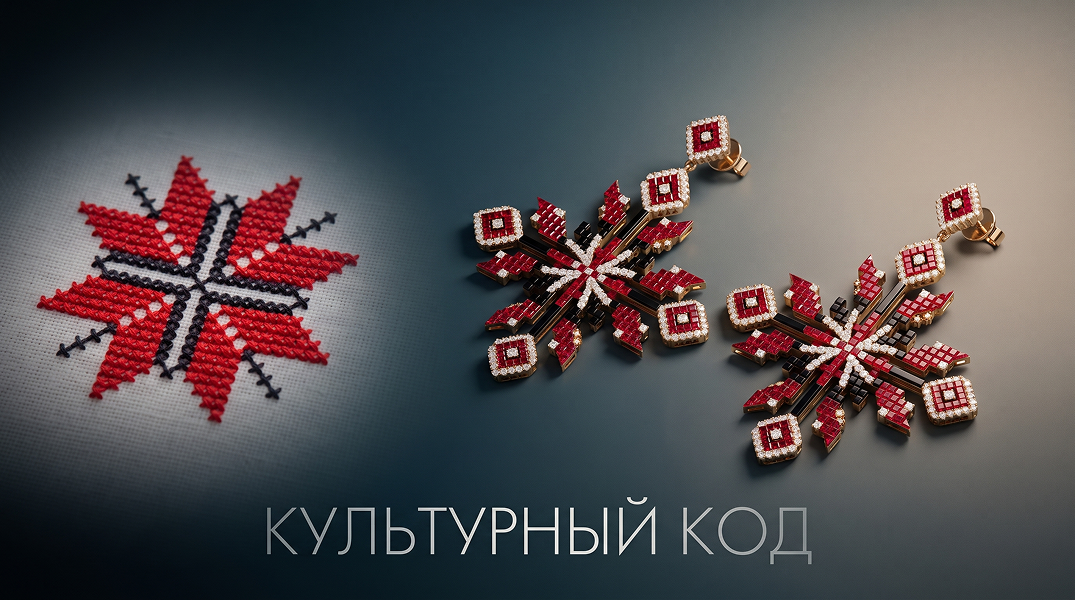
КУЛЬТУРНЫЙ КОД
сквозь времена и поколения
КОНЦЕПЦИЯ
Концепция и сюжет этого видео я выстроила вокруг теории нелинейности времени: в кадрах прошлое и настоящее существуют параллельно. Цель этой концепции - показать, как наследие наших предков продолжает существовать и иметь на нас влияние.
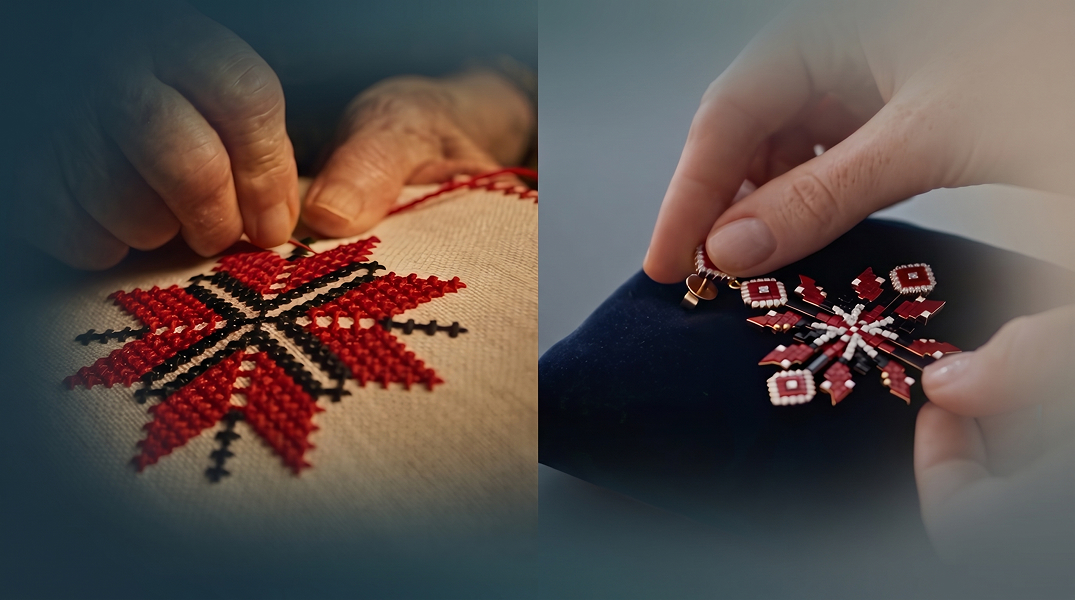
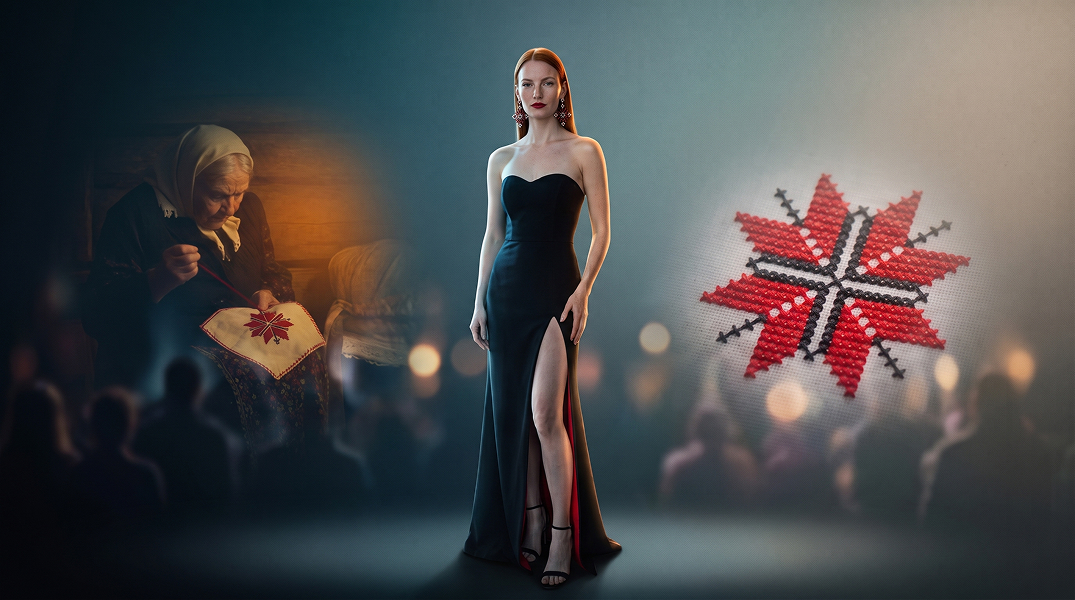
Наследие — это не музейная витрина, а живая связь, которая проявляется в моменте творчества. Бабушка вышивает орнамент — внучка создаёт украшение с тем же орнаментом в основе — и обе, в разных эпохах, делают это параллельно. Код замыкается в петлю.
ИДЕЯ И СЦЕНАРИЙ
Идея создания сережек на основе русского орнамента в виде звезды с восьмью лучами, которая является древним символом, принадлежит мне. Осуществить задуманное мне помогли Midjourney и Nana Banana.
Сценарий написан с помощью Claude.
Классическая структура — прошлое → настоящее → триумф — казалась мне слишком линейной для темы культурного кода. Поэтому я выбрала нелинейный сценарий: девушка перед зеркалом видит в отражении не себя, а бабушку, вышивающую узор. Они совершают синхронное действие в разных временах. Узор распадается на частицы и летит сквозь три эпохи — деревянная изба, советская квартира, современное пространство — собираясь обратно в украшение на ухе героини.
Этим я хотела сказать: код не движется из прошлого в будущее. Он существует одновременно. Каждое поколение — и получатель, и отправитель. Бабушка вышивает — и этот узор уже есть на серьгах внучки, ещё до того, как она их создала. Время здесь — петля, а не стрела.
ВИЗУАЛЬНЫЙ ЯЗЫК
Визуальный язык ролика выстроен так, чтобы каждый технический момент нёс смысл.
Камера: RED Komodo 6K + Cooke S4 50mm — это классическая оптика "с душой". Cooke даёт мягкое боке и тёплую передачу кожи. Это противоположность цифровой стерильности. Я хотела, чтобы ролик выглядел как кино, а не контент.
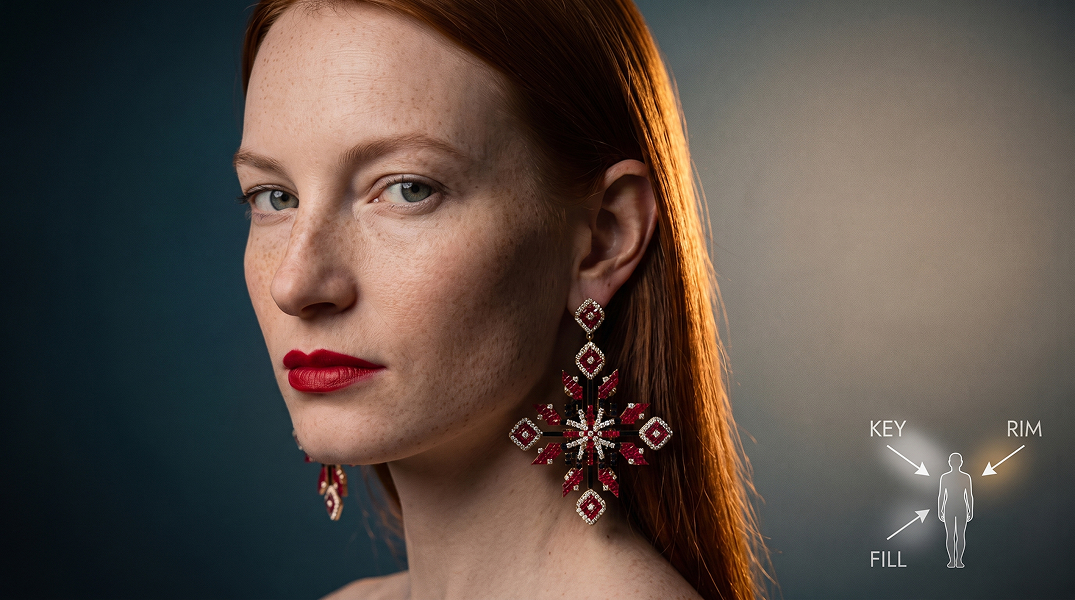
Свет: боковой + контровой тёплый - дают эффект объема. Каждый кадр трёхмерный. Контровой свет на волосах и плечах — это отсылка к классическому портрету, где свет лепит форму, а не просто освещает.
Цвет: вся палитра десатурирована — холодный серо-синий и тёплый приглушённый янтарь. Красный — единственный насыщенный цвет в ролике, и он появляется только в узоре, серьгах, губах и подкладке платья. Это не случайность — красный здесь символ самого кода, передающегося сквозь время. Всё остальное — фон.
Композиция: кадры в основном асимметричны, построены по правилу третей или золотой спирали. Три плана глубины во многих кадрах дают больше кинематографичности. Это создаёт пространство, в которое зритель "входит", а не просто смотрит на экран.
ИИ ТЕХНОЛОГИИ
Я использовала несколько ИИ-инструментов, каждый решал конкретную творческую задачу.
Higgsfield Soul — создание героини. Я генерировала лицо девушки с естественной асимметрией, веснушками, видимыми порами. Задача была не в том, чтобы сделать «красивое лицо», а в том, чтобы создать характер — узнаваемый, живой, с историей в чертах.
Nano Banana — помогла собрать воедино весь образ персонажа. Здесь я дорабатывала дизайн серег, портреты девушки в вечернем образе, коллажи для кейса. Nano Banana держит детали и даёт контроль — именно то, что нужно для создания реалистичной картинки.
Seedance 2.5 — генерация всего ролика целиком, я генерировала 20 секунд одним промптом. Это ключевой выбор: я могла нарезать сцены и склеить в монтаже, но цельная генерация даёт единый стиль, одно зерно, один свет. Переходы между кадрами — это не монтажные склейки, а события внутри мира: узор распадается, частицы летят, собираются обратно. ИИ показывает это как непрерывное движение, которое камера снять не может.
Таким образом — ИИ — не замена оператору или художнику. Это инструмент, который расширяет возможности творческих личностей и дает им возможность показать свой мир.
ПРОМТЫ
Промты написаны с помощью Claude, разместила два промта для Seedance 2.5 ниже, из двух видео в итоге получилось одно, монтаж и текст в VN.
=== GLOBAL STYLE — APPLIES TO ALL 20 SECONDS ===
Cinematic short film, 16:9 horizontal, 24 fps, one continuous piece
in a single unified look and grade.
CAMERA BODY AND LENS FOR THE ENTIRE FILM:
Shot on RED Komodo 6K with a Cooke S4 50mm prime lens at T2.0.
The Cooke Look: warm romantic rendering, gentle roll-off in the
highlights, soft slightly oval bokeh with character, delicate halation
around bright sources, organic natural skin tones, no digital
sharpening, no clinical sterility. Shallow depth of field throughout.
Fine organic film grain. Subtle natural lens breathing on focus pulls.
COMPOSITION DOCTRINE:
Every frame is asymmetric. The subject sits off the centre axis,
in the left or right third, never centred. Strong negative space.
Every frame is built in three distinct planes of depth — a sharp
foreground element close to the lens, the subject in the middle
ground, and a deep soft background that is blurred but still legible.
Shot sizes alternate deliberately: extreme close-up, medium,
abstract, extreme close-up, full shot, close-up.
LIGHTING DOCTRINE:
Every shot is lit with a hard directional side key plus a warm rim
backlight from the opposite side. The rim light always separates the
subject's shoulder, jaw and hair from the background with a thin
luminous edge. Ambient light stays low and moody. Deep shadows with
retained detail. Volumetric, three-dimensional, sculpted.
Never flat, never evenly lit.
COLOUR PALETTE — STRICT:
The whole film is desaturated cool teal-grey and warm muted amber.
Shadows lean cyan-blue. Midtones neutral. Highlights warm beige.
Overall saturation is low.
RED IS THE ONLY SATURATED COLOUR IN THE FILM and it appears ONLY as:
the embroidery thread, the glowing particles, the ruby stones of the
earrings, the heroine's lipstick, and the red silk lining of her gown.
Everything else — walls, wood, fabric, skin, background — stays muted.
The red must read as the single burning accent against a dark
restrained world.
PAST (grandmother) is warmer, 2800K, amber, softly aged, light film
grain heavier. PRESENT (heroine) is cooler, 5200K, cleaner, crisper.
Both share one grade, they differ only in temperature.
CHARACTERS:
GRANDMOTHER — only her hands are ever seen. Aged, veined, strong
working hands. Her face is NEVER visible, never in frame, not even
partially, not even in reflection except as a dark featureless
silhouette.
HEROINE — the young woman from the reference images. 25 years old,
very long straight copper red hair, pale skin with freckles across
the nose bridge and cheeks, grey-green eyes, natural facial asymmetry
with eyelids at slightly different heights and uneven brow line.
Preserve her face and proportions identically in every single shot
of the film. Never beautify, never symmetrise, never change her hair
colour or length. Skin stays photoreal with visible pores, retouched
only for even tone. Lipstick is a warm-neutral red with a coral-brick
undertone, satin finish, matched to the ruby stones.
THE EARRINGS — from the reference. Large eight-pointed stepped
geometric rosette, mosaic of square-cut rubies, black onyx and white
diamonds in a precise grid, yellow gold framework, diamond halos,
with small detached diamond-shaped elements above and below. Both
earrings identical. They keep their exact geometry in every frame,
they never deform, never change colour, never lose stones. They hang
with realistic weight, tilting slightly forward, casting soft shadow
on the neck.
THE PATTERN — from the reference. Eight-pointed stepped cross-stitch
rosette, red thread with black accents on white linen. Its geometry
is identical to the geometry of the earrings.
MUSIC AND SOUND DOCTRINE:
The score is orchestral and atmospheric, never rhythmic or electronic.
No drums, no kick, no percussion, no beat, no club drop, no trap,
no EDM riser. The music flows as one continuous swelling wave built
from sustained strings, cello, low harmonium drone and a wordless
female voice. Transitions are marked by tonal and harmonic shifts,
soft glissandi, bowed metal and reversed cymbal swells — never by
a drum hit. Reference feeling: Jóhann Jóhannsson, Hildur Guðnadóttir,
Max Richter. Slow, reverent, emotional, spacious.
NO text, no captions, no subtitles, no titles, no logos, no watermark
anywhere in the film.
=== 0:00 — 0:04 · SHOT 1 · TWO HANDS, ONE GESTURE ===
The frame is split by a soft vertical seam of light down the middle,
two eras bleeding into each other rather than a hard graphic divide.
The seam is diffuse and feathered, the two worlds gently overlapping.
LEFT HALF, past, warm amber: the aged hands of an elderly woman drive
a needle with red thread through white linen, completing the
eight-pointed stepped rosette. Old wooden table, rough linen, a dim
window far behind.
RIGHT HALF, present, cool grey: the young hands of the heroine lower
one finished earring onto a dark velvet pad. Pale stone surface,
jeweller's tools, a bright modern window far behind.
The two actions are perfectly synchronised — as the needle pierces
the linen, the earring touches the velvet; as the thread pulls
through, the young hand lifts away.
FRAMING: extreme close-up. Hands only, wrist to fingertips. No faces.
DEPTH: foreground — needle, thread, earring, razor sharp. Middle —
the table edges, wood on the left, stone on the right. Background —
two windows, deep creamy bokeh, legible but abstract.
CAMERA: locked off, completely static. Slight high angle, 30 degrees
down, documentary craft perspective. Absolute stillness.
LIGHT: left — warm hard side light raking across the linen from a
window, Rembrandt triangle on the knuckles, soft amber rim from
behind. Right — cool hard side light from the left, crisp specular
highlights on the gold and stones, cold rim from behind right.
SOUND: near silence. The dry rasp of thread pulling through linen on
the left, a tiny metallic tick as the earring settles on the right,
in unison. At 0:03 a barely audible low cello drone enters and begins
to swell, joined by a thin sustained glassy overtone. No rhythm.
=== 0:04 — 0:07 · SHOT 2 · THE DISSOLVE IN THE MIRROR ===
A strikingly modern room, dimly lit, warm and lived-in rather than
empty. Contemporary designer interior, fully furnished: a large
frameless full-height mirror with a thin integrated LED edge, smooth
pale micro-cement walls, a low sculptural walnut console with objects
on it, a deep boucle armchair, a linen upholstered bench at the foot
of a low platform bed with rumpled white bedding, an open wardrobe
with hanging garments, a tall arc floor lamp, a stack of art books,
a ceramic vase with dried branches, a soft textured rug, matte black
fixtures, a floor-to-ceiling window with a blurred night city beyond.
Clean modern lines, warm materials, richly dressed and inhabited,
unmistakably a present-day apartment, not a bare empty set.
The heroine sits at the mirror in the black strapless evening gown,
long copper hair pulled back behind her ears. She looks into the
mirror. In the reflection she is not there — instead, seated in
exactly her pose, is the grandmother, seen only as a dark silhouette
and her hands, embroidering the red rosette. The reflected world
behind the grandmother is the old wooden village room, warm and aged,
in direct contrast to the modern room in front of the glass.
The heroine slowly raises one hand toward her ear to put on an
earring. The reflected grandmother raises the needle at the exact
same moment. The instant the earring touches the earlobe, the
embroidered pattern in the mirror ignites from within and bursts
apart into thousands of tiny glowing red particles that pour out of
the mirror into the modern room, swirling around the heroine.
The particles hold the geometry of the rosette even as they scatter.
FRAMING: medium shot, waist up, holding the heroine, the mirror and
the console.
COMPOSITION: inverted thirds. The heroine sits in the right third in
profile, the mirror occupies the left two thirds and dominates the
frame. She is the reaction, the mirror is the event.
DEPTH: foreground — the console edge with the embroidered linen and an
open jewellery box, sharp. Middle — the heroine in profile, sharp.
Background — the mirror and the silhouette inside it, also sharp,
a deliberate magical-realist break from optical logic. The furnished
room reads clearly in the soft background.
CAMERA: extremely slow dolly in toward the mirror, barely 20 cm
across the whole shot, almost imperceptible pressure building.
LIGHT: room ambience crushed low, lit only by practicals — the cold
LED edge of the mirror, the arc floor lamp, the distant city window.
The heroine is carved out by a hard narrow side key from the left and
a warm rim from behind right that traces her shoulder, jaw and hair in
a thin golden line. The mirror glows from inside with its own warm
amber light, as if the grandmother sits in another space — warm past
against cool modern present. The particles are cold saturated red,
self-illuminating, throwing red bounce onto her cheek, collarbone and
the pale micro-cement wall.
SOUND: dead silence and one held breath. A faint rustle of fabric
from inside the mirror. At 0:06 the pattern ignites — a soft high
glass-harmonica swell, then the dissolve: thousands of tiny crystalline
clicks like a glass ornament shattering in slow motion, wrapped in a
rising bowed-metal shimmer. The cello drone rises underneath.
No percussion.
=== 0:07 — 0:10 · SHOT 3 · THE FLOW THROUGH THREE ERAS ===
Pure movement, and a clear journey through exactly three worlds,
in strict chronological order.
The red glowing particles stream out of the mirror and rush past the
lens, leaving light trails. The camera flies with them.
ERA ONE, 0:07 to 0:08 — OLD RUSSIAN VILLAGE HOUSE. The camera races
through the interior of a wooden izba: dark hand-hewn log walls, a low
beamed ceiling, a whitewashed masonry stove, small deep-set windows
with simple wooden frames, embroidered linen towels hanging on the
walls, a wooden loom, clay vessels, an oil lamp, worn plank floors.
Warm amber, 2800K, dusty, heavy grain, air thick with floating motes.
THRESHOLD ONE, at 0:08 — the particles pass through a soft vertical
veil of light and the world changes. Colour temperature shifts upward.
ERA TWO, 0:08 to 0:09 — SOVIET-ERA APARTMENT, 1970s. The camera races
through a cramped flat: patterned beige-brown wallpaper, a dark
lacquered sideboard with cut-crystal glassware behind glass doors,
a patterned rug hanging on the wall, a folding dining table with an
oilcloth cover, a boxy cathode-ray television with a lace doily and a
small vase on top, a glass-fronted bookcase of matching hardback
spines, a pendant lamp with a fabric shade, parquet flooring,
a rubber plant in the corner. Neutral warm olive-beige, 3800K,
moderate grain, slightly hazy air.
THRESHOLD TWO, at 0:09 — the particles pass through a second soft
vertical veil of light. Colour temperature snaps cool.
ERA THREE, 0:09 to 0:10 — CONTEMPORARY APARTMENT. The camera races
through a modern furnished space: floor-to-ceiling glass walls,
polished concrete and pale micro-cement, low sculptural sofa, walnut
console, recessed linear lighting, large abstract artwork, a cold night
city glittering outside. Cool blue, 5200K, clean, crisp, almost no
grain, air completely clear.
The three eras are visually distinct and immediately readable — dark
warm handmade wood, then cluttered patterned soviet domesticity, then
cool minimal glass and concrete. The particles stretch into a single
luminous thread while still carrying the stepped geometry of the
rosette, and at the end of the shot they decelerate and begin to draw
together.
FRAMING: abstract, no human scale. The camera is inside the stream.
COMPOSITION: hard diagonal. Particles travel from upper left to lower
right, dragging the eye across the frame.
DEPTH: foreground — a few large particles passing centimetres from the
lens, heavy motion blur. Middle — the main body of the stream, sharp,
holding the pattern. Background — the interiors rushing past, radial
blur, receding into infinity but always clearly readable as izba,
soviet flat or modern apartment.
CAMERA: continuous fast dolly forward at the speed of the particles,
with a slow 15 degree roll on the lens axis for gentle vertigo.
The move never stops or cuts across all three eras.
LIGHT: the particles are the only travelling light source. Volumetric
red glow, red light spill on log walls, then on wallpaper and crystal
glassware, then on concrete and glass. The izba is lit dimly by warm
amber oil light; the soviet flat by a single warm tungsten pendant;
the modern apartment by cold blue city light and thin linear LEDs.
Soft Cooke halation and gentle lens flare as particles cross the lens,
and a soft blooming flare on each threshold.
SOUND: a continuous orchestral swell, no rhythm at all. Sustained
strings rise in a slow crescendo with a low harmonium drone beneath.
At 0:08, on the first threshold, the harmony lifts a whole step and a
reversed cymbal swell blooms — a tonal marker, not a drum hit.
At 0:09, on the second threshold, the harmony lifts again and a bowed
metal shimmer with a high glass tone marks the change. The strings
reach their peak at 0:09.7. At 0:10 everything resolves and drops away
into 0.3 seconds of total silence. No kick, no beat, no riser,
no electronic drop.
=== 0:10 — 0:14 · SHOT 4 · THE EARRING ===
The particles settle and collapse inward, reassembling into the
finished earring already resting against the heroine's earlobe. She
stands before the mirror in the modern furnished room, now an ordinary
mirror reflecting only herself. She closes the clasp with her
fingertips, lowers her hand, and lifts her chin. As the camera passes
the mirror, for less than half a second a faint double exposure of the
grandmother's silhouette ghosts across the reflection, then is gone.
FRAMING: extreme close-up. Chin to brow. The earring fills a third
of the frame.
COMPOSITION: golden spiral. Her eye near the optical centre, the
earring landing on the outer turn of the spiral. Frame breathing,
alive, never static.
DEPTH: foreground — the earring, macro sharp, every facet of every
square ruby, onyx and diamond individually readable, gold framework
crisp. Middle — skin, pores, freckles, the red lips, the edge of the
hair, sharp. Background — the mirror and the dark furnished room,
soft bokeh, legible.
CAMERA: orbital move. The camera arcs around her head through 120
degrees over four seconds on a 60 cm radius, strictly horizontal,
never rising or falling, focus locked on her face. It begins frontal,
passes through profile, and ends three-quarter behind her shoulder
with the earring hanging free and fully lit against the dark room.
LIGHT: hard narrow key from the front left carving a Rembrandt
triangle on her cheek. Warm 3200K rim from behind right laying a gold
line along her hair and the ridge of her shoulder. A dim practical
glow from the mirror's LED edge as fill. The earring catches all three
sources at once — hard specular sparks travelling across the stones as
the camera orbits.
SOUND: silence after the resolve, only her breath. At 0:11 a tiny
metallic click as the clasp closes. At 0:12 a low cello note on G
enters beneath, very quiet. At 0:13 a wordless female vocalise joins,
slavic in intonation, haunting, no words. At 0:14 the voice recedes
into a long reverb tail. No percussion.
=== 0:14 — 0:17 · SHOT 5 · THE DOOR ===
The heroine stands in the dark room with her back to the lens, in the
full-length black gown, the red silk lining flashing inside the high
slit as she moves. She takes three steps to a tall door and pushes it
open. Behind it: blinding white stage light and the silhouettes of an
audience. She walks through. The door begins to swing shut behind her.
Through the closing gap, camera flashes pop and applause swells.
The door closes.
FRAMING: full shot, head to floor, then the empty doorway.
COMPOSITION: a portal in darkness. The lit rectangle of the doorway
sits slightly off the centre axis, she stands to the right of it —
asymmetric, unstable, forward-leaning.
DEPTH: foreground — the door jamb, sharp. Middle — her full figure,
sharp. Background — the hall beyond, three stops overexposed, pure
white, only silhouettes readable.
CAMERA: locked off at a low angle, lens near floor height, tilted
slightly up at her. As the door closes, a slow 20 cm crane up,
like an exhale.
LIGHT: the room is effectively black. She is a pure silhouette against
the doorway, the only detail a hot white contour along the gown and
the red sparks of the earrings catching the edge light beside her
jaw. The hall behind blows out to clean white.
SOUND: three heel steps on wood. The door's slow groan. A rising murmur
of a crowd, cloth and voices. One single clap, then a second, then
applause breaking like a wave. The door shuts on a dull heavy thud
and the applause drops behind it to a muffled roar. Strings sustain
softly underneath.
=== 0:17 — 0:20 · SHOT 6 · HER FACE, FINAL ===
Cut through the door and we are on the other side, facing her as she
emerges into the light in front of the audience. Close on the heroine
in the black gown, both earrings clearly visible, long copper hair
falling behind her shoulders. She steps forward into the stage light
and looks directly into the lens — calm, grounded, certain. Behind her
the hall dissolves into warm out-of-focus lights and dark silhouettes.
In the last second she raises her chin a fraction: recognition,
not pride.
The air around her is completely clear and empty. There are no
particles, no crystals, no sparks, no glowing fragments, no floating
elements of any kind anywhere in this shot. Nothing moves in the frame
except the heroine herself. Just her face and the earrings, clean and
uninterrupted. The image holds still, then falls to black.
FRAMING: begins medium close-up, chest up, ends tight close-up on her
face and one earring filling the frame.
COMPOSITION: she sits in the left third, the warm depth of the hall
opening to the right. Asymmetric, composed, final.
DEPTH: foreground — the earring and her face, macro sharp, every stone
readable, pores and freckles visible. Middle — shoulders and the line
of the gown, sharp. Background — round warm bokeh balls of stage light
and audience silhouettes, deeply soft.
CAMERA: slow steady push in, 40 cm over three seconds, easing to a
complete stop on her face. The image holds frozen for the final beat.
LIGHT: soft frontal key sculpting her face without flattening it, hard
side light from the left igniting the ruby facets, warm rim from behind
laying gold along her hair and shoulders, practical stage lights
glowing behind her. The red of the stones and the red of her lips are
the brightest saturated points in the entire film.
SOUND: the applause thins to a steady distant clap. At 0:19 the clap
transforms into a slow low heartbeat at 80 BPM. At 0:20 the heartbeat
fades into silence. Leave the final frame and the black clean, with no
music sting, no text, no sound.
=== NEGATIVE — AVOID ===
no visible face of the elderly woman, no baby, no cradle, no children,
no text, no captions, no subtitles, no titles, no logo, no watermark,
no additional jewellery, no necklace, no rings, no bracelets,
no deformed or asymmetrical mismatched earrings, no change in the
earring geometry or colour, no missing stones, no change in the
heroine's hair length or colour, no face morphing between shots,
no identity drift, no beautified or symmetrised face, no plastic
airbrushed skin, no cartoon, no illustration, no 3D render look,
no oversaturated colours, no red anywhere except the specified
elements, no green or blue costume accents, no excessive lens flare,
no strobing, no warping hands, no extra fingers, no extra limbs,
no crowd faces in focus, no modern branding in the past scenes,
no vertical framing, no hard graphic split line in the opening shot,
no split screen after 0:04,
no particles or crystals or sparks in the final shot,
no empty or unfurnished room at the mirror,
no rustic wooden or vintage interior in the room at the mirror,
no drums, no kick drum, no percussion, no beat, no electronic riser,
no club drop, no EDM, no trap, no hip hop, no rhythmic pulse in the
transition,
no eras out of chronological order,
no skipping the soviet-era apartment
=== GLOBAL STYLE — APPLIES TO ALL 20 SECONDS ===
Cinematic short film, 16:9 horizontal, 24 fps, one continuous piece
in a single unified look and grade.
CAMERA BODY AND LENS FOR THE ENTIRE FILM:
Shot on RED Komodo 6K with a Cooke S4 50mm prime lens at T2.0.
The Cooke Look: warm romantic rendering, gentle roll-off in the
highlights, soft slightly oval bokeh with character, delicate halation
around bright sources, organic natural skin tones, no digital
sharpening, no clinical sterility. Shallow depth of field throughout.
Fine organic film grain. Subtle natural lens breathing on focus pulls.
COMPOSITION DOCTRINE:
Every frame is asymmetric. The subject sits off the centre axis,
in the left or right third, never centred. Strong negative space.
Every frame is built in three distinct planes of depth — a sharp
foreground element close to the lens, the subject in the middle
ground, and a deep soft background that is blurred but still legible.
Shot sizes alternate deliberately: extreme close-up, medium,
abstract, extreme close-up, full shot, close-up.
LIGHTING DOCTRINE:
Every shot is lit with a hard directional side key plus a warm rim
backlight from the opposite side. The rim light always separates the
subject's shoulder, jaw and hair from the background with a thin
luminous edge. Ambient light stays low and moody. Deep shadows with
retained detail. Volumetric, three-dimensional, sculpted.
Never flat, never evenly lit.
COLOUR PALETTE — STRICT:
The whole film is desaturated cool teal-grey and warm muted amber.
Shadows lean cyan-blue. Midtones neutral. Highlights warm beige.
Overall saturation is low.
RED IS THE ONLY SATURATED COLOUR IN THE FILM and it appears ONLY as:
the embroidery thread, the glowing particles, the ruby stones of the
earrings, the heroine's lipstick, and the red silk lining of her gown.
Everything else — walls, wood, fabric, skin, background — stays muted.
The red must read as the single burning accent against a dark
restrained world.
PAST (grandmother) is warmer, 2800K, amber, softly aged, light film
grain heavier. PRESENT (heroine) is cooler, 5200K, cleaner, crisper.
Both share one grade, they differ only in temperature.
CHARACTERS:
GRANDMOTHER — only her hands are ever seen. Aged, veined, strong
working hands. Her face is NEVER visible, never in frame, not even
partially, not even in reflection except as a dark featureless
silhouette.
HEROINE — the young woman from the reference images. 25 years old,
very long straight copper red hair, pale skin with freckles across
the nose bridge and cheeks, grey-green eyes, natural facial asymmetry
with eyelids at slightly different heights and uneven brow line.
Preserve her face and proportions identically in every single shot
of the film. Never beautify, never symmetrise, never change her hair
colour or length. Skin stays photoreal with visible pores, retouched
only for even tone. Lipstick is a warm-neutral red with a coral-brick
undertone, satin finish, matched to the ruby stones.
THE EARRINGS — from the reference. Large eight-pointed stepped
geometric rosette, mosaic of square-cut rubies, black onyx and white
diamonds in a precise grid, yellow gold framework, diamond halos,
with small detached diamond-shaped elements above and below. Both
earrings identical. They keep their exact geometry in every frame,
they never deform, never change colour, never lose stones. They hang
with realistic weight, tilting slightly forward, casting soft shadow
on the neck.
THE PATTERN — from the reference. Eight-pointed stepped cross-stitch
rosette, red thread with black accents on white linen. Its geometry
is identical to the geometry of the earrings.
NO text, no captions, no subtitles, no titles, no logos, no watermark
anywhere in the film.
=== 0:00 — 0:04 · SHOT 1 · TWO HANDS, ONE GESTURE ===
The frame is split by a soft vertical seam of light down the middle,
two eras bleeding into each other rather than a hard graphic divide.
LEFT HALF, past, warm amber: the aged hands of an elderly woman drive
a needle with red thread through white linen, completing the
eight-pointed stepped rosette. Old wooden table, rough linen, a dim
window far behind.
RIGHT HALF, present, cool grey: the young hands of the heroine lower
one finished earring onto a dark velvet pad. Pale stone surface,
jeweller's tools, a bright modern window far behind.
The two actions are perfectly synchronised — as the needle pierces
the linen, the earring touches the velvet; as the thread pulls
through, the young hand lifts away.
FRAMING: extreme close-up. Hands only, wrist to fingertips. No faces.
DEPTH: foreground — needle, thread, earring, razor sharp. Middle —
the table edges, wood on the left, stone on the right. Background —
two windows, deep creamy bokeh, legible but abstract.
CAMERA: locked off, completely static. Slight high angle, 30 degrees
down, documentary craft perspective. Absolute stillness.
LIGHT: left — warm hard side light raking across the linen from a
window, Rembrandt triangle on the knuckles, soft amber rim from
behind. Right — cool hard side light from the left, crisp specular
highlights on the gold and stones, cold rim from behind right.
SOUND: near silence. The dry rasp of thread pulling through linen on
the left, a tiny metallic tick as the earring settles on the right,
in unison. At 0:03 a barely audible 40 Hz sub-bass tone enters and
begins to swell, joined by a thin glassy overtone.
=== 0:04 — 0:07 · SHOT 2 · THE DISSOLVE IN THE MIRROR ===
A strikingly modern room, dimly lit, almost black. Contemporary
minimalist architecture: a large frameless full-height mirror with a
thin integrated LED edge, smooth pale micro-cement walls, a low
sculptural walnut console, matte black fixtures, a floor-to-ceiling
window with a blurred night city beyond, a single slender designer
lamp. Clean hard lines, no ornament, no clutter, unmistakably
present-day luxury interior.
The heroine sits at the mirror in the black strapless evening gown,
long copper hair pulled back behind her ears. She looks into the
mirror. In the reflection she is not there — instead, seated in
exactly her pose, is the grandmother, seen only as a dark silhouette
and her hands, embroidering the red rosette. The reflected world
behind the grandmother is the old wooden village room, warm and aged,
in direct contrast to the cold modern room in front of the glass.
The heroine slowly raises one hand toward her ear to put on an
earring. The reflected grandmother raises the needle at the exact
same moment. The instant the earring touches the earlobe, the
embroidered pattern in the mirror ignites from within and bursts
apart into thousands of tiny glowing red particles that pour out of
the mirror into the modern room, swirling around the heroine.
The particles hold the geometry of the rosette even as they scatter.
FRAMING: medium shot, waist up, holding the heroine, the mirror and
the console.
COMPOSITION: inverted thirds. The heroine sits in the right third in
profile, the mirror occupies the left two thirds and dominates the
frame. She is the reaction, the mirror is the event.
DEPTH: foreground — the console edge with the embroidered linen and an
open jewellery box, sharp. Middle — the heroine in profile, sharp.
Background — the mirror and the silhouette inside it, also sharp,
a deliberate magical-realist break from optical logic.
CAMERA: extremely slow dolly in toward the mirror, barely 20 cm
across the whole shot, almost imperceptible pressure building.
LIGHT: room ambience crushed to near black, only the cold LED edge of
the mirror and the distant city window as practicals. The heroine is
carved out by a hard narrow side key from the left and a warm rim from
behind right that traces her shoulder, jaw and hair in a thin golden
line. The mirror glows from inside with its own warm amber light, as
if the grandmother sits in another space — warm past against cold
modern present. The particles are cold saturated red, self-illuminating,
throwing red bounce onto her cheek, collarbone and the pale
micro-cement wall.
SOUND: dead silence and one held breath. A faint rustle of fabric
from inside the mirror. At 0:06 the pattern ignites — a sharp high
glass-harmonica ring, then the dissolve: thousands of tiny crystalline
clicks like a glass ornament shattering in slow motion, wrapped in a
rising air whoosh.
=== 0:07 — 0:10 · SHOT 3 · THE FLOW THROUGH TIME ===
Pure movement, and a single clear leap between exactly two worlds.
The red glowing particles stream out of the mirror and rush past the
lens, leaving light trails. The camera flies with them.
FIRST HALF, 0:07 to 0:08.5 — the camera races through the interior of
an old Russian village house: dark hand-hewn log walls, a low beamed
ceiling, a whitewashed masonry stove, small deep-set windows with
simple wooden frames, embroidered linen towels hanging on the walls,
a wooden loom, clay vessels, an oil lamp, worn plank floors.
Everything warm amber, 2800K, dusty, heavy grain, air thick with
floating motes.
THE THRESHOLD, at 0:08.5 — the particles punch through a blinding
vertical wall of white light, a single hard threshold between eras.
Colour temperature snaps over in one frame.
SECOND HALF, 0:08.5 to 0:10 — the camera races through a contemporary
apartment: floor-to-ceiling glass walls, polished concrete and pale
micro-cement, a wide open plan, minimal low furniture, recessed linear
lighting, a cold night city glittering outside. Everything cool blue,
5200K, clean, crisp, almost no grain, air completely clear.
The contrast between the two halves is deliberate and extreme — dark
warm cluttered handmade wood against bright cold empty engineered
glass and concrete. The particles stretch into a single luminous
thread while still carrying the stepped geometry of the rosette, and
at the end of the shot they decelerate and begin to draw together.
FRAMING: abstract, no human scale. The camera is inside the stream.
COMPOSITION: hard diagonal. Particles travel from upper left to lower
right, dragging the eye across the frame.
DEPTH: foreground — a few large particles passing centimetres from the
lens, heavy motion blur. Middle — the main body of the stream, sharp,
holding the pattern. Background — the interiors rushing past, radial
blur, receding into infinity but always clearly readable as either
old village house or modern apartment.
CAMERA: aggressive fast dolly forward at the speed of the particles,
with a slow 15 degree roll on the lens axis for controlled vertigo.
LIGHT: the particles are the only travelling light source. Volumetric
red glow, red light spill on log walls in the first half and on
concrete and glass in the second. The village house is lit dimly from
within by warm amber oil light; the modern apartment by cold blue city
light and thin linear LEDs. Soft Cooke halation and gentle lens flare
as particles cross the lens, and a hard flare burst on the white
threshold at 0:08.5.
SOUND: the whoosh opens into a rising synth pad in D minor. At 0:08 a
soft 120 BPM kick pulse enters. At 0:08.5, on the threshold, a sharp
transient hit — a single deep impact with a bright metallic tail,
marking the jump between eras. At 0:09 the pulse hardens and a white
noise riser climbs. At 0:10 everything cuts out into 0.3 seconds of
total silence.
=== 0:10 — 0:14 · SHOT 4 · THE EARRING ===
The particles settle and collapse inward, reassembling into the
finished earring already resting against the heroine's earlobe. She
stands before the mirror in the modern room, now an ordinary mirror
reflecting only herself. She closes the clasp with her fingertips,
lowers her hand, and lifts her chin. As the camera passes the mirror,
for less than half a second a faint double exposure of the
grandmother's silhouette ghosts across the reflection, then is gone.
FRAMING: extreme close-up. Chin to brow. The earring fills a third
of the frame.
COMPOSITION: golden spiral. Her eye near the optical centre, the
earring landing on the outer turn of the spiral. Frame breathing,
alive, never static.
DEPTH: foreground — the earring, macro sharp, every facet of every
square ruby, onyx and diamond individually readable, gold framework
crisp. Middle — skin, pores, freckles, the red lips, the edge of the
hair, sharp. Background — the mirror and the dark modern room, soft
bokeh, legible.
CAMERA: orbital move. The camera arcs around her head through 120
degrees over four seconds on a 60 cm radius, strictly horizontal,
never rising or falling, focus locked on her face. It begins frontal,
passes through profile, and ends three-quarter behind her shoulder
with the earring hanging free and fully lit against the dark room.
LIGHT: hard narrow key from the front left carving a Rembrandt
triangle on her cheek. Warm 3200K rim from behind right laying a gold
line along her hair and the ridge of her shoulder. A dim practical
glow from the mirror's LED edge as fill. The earring catches all three
sources at once — hard specular sparks travelling across the stones as
the camera orbits.
SOUND: silence after the drop, only her breath. At 0:11 a tiny
metallic click as the clasp closes. At 0:12 a low cello note on G
enters beneath, very quiet. At 0:13 a wordless female vocalise joins,
slavic in intonation, haunting, no words. At 0:14 the voice recedes
into a long reverb tail.
=== 0:14 — 0:17 · SHOT 5 · THE DOOR ===
The heroine stands in the dark room with her back to the lens, in the
full-length black gown, the red silk lining flashing inside the high
slit as she moves. She takes three steps to a tall door and pushes it
open. Behind it: blinding white stage light and the silhouettes of an
audience. She walks through. The door begins to swing shut behind her.
Through the closing gap, camera flashes pop and applause swells.
The door closes.
FRAMING: full shot, head to floor, then the empty doorway.
COMPOSITION: a portal in darkness. The lit rectangle of the doorway
sits slightly off the centre axis, she stands to the right of it —
asymmetric, unstable, forward-leaning.
DEPTH: foreground — the door jamb, sharp. Middle — her full figure,
sharp. Background — the hall beyond, three stops overexposed, pure
white, only silhouettes readable.
CAMERA: locked off at a low angle, lens near floor height, tilted
slightly up at her. As the door closes, a slow 20 cm crane up,
like an exhale.
LIGHT: the room is effectively black. She is a pure silhouette against
the doorway, the only detail a hot white contour along the gown and
the red sparks of the earrings catching the edge light beside her
jaw. The hall behind blows out to clean white.
SOUND: three heel steps on wood. The door's slow groan. A rising murmur
of a crowd, cloth and voices. One single clap, then a second, then
applause breaking like a wave. The door shuts on a dull heavy thud
and the applause drops behind it to a muffled roar.
=== 0:17 — 0:20 · SHOT 6 · THE HEROINE, FINAL ===
Cut through the door and we are on the other side. The heroine stands
in the stage light in the black gown, both earrings clearly visible,
long copper hair falling behind her shoulders. She looks directly into
the lens — calm, grounded, certain. Behind her the hall dissolves into
warm out-of-focus lights and dark silhouettes. In the last second she
raises her chin a fraction: recognition, not pride.
The air around her is completely clear and empty. There are no
particles, no crystals, no sparks, no glowing fragments, no floating
elements of any kind anywhere in this shot. Nothing moves in the frame
except the heroine herself. Just her face and the earrings, clean and
uninterrupted. The image holds still, then falls to black.
FRAMING: begins medium close-up, chest up, ends close-up on her face
and one earring.
COMPOSITION: she sits in the left third, the warm depth of the hall
opening to the right. Asymmetric, composed, final.
DEPTH: foreground — the earring and her face, macro sharp, every stone
readable. Middle — shoulders and the line of the gown, sharp.
Background — round warm bokeh balls of stage light and audience
silhouettes, deeply soft.
CAMERA: slow steady push in, 40 cm over three seconds, easing to a
complete stop on her face. The image holds frozen for the final beat.
LIGHT: soft frontal key sculpting her face without flattening it, hard
side light from the left igniting the ruby facets, warm rim from behind
laying gold along her hair and shoulders, practical stage lights
glowing behind her. The red of the stones and the red of her lips are
the brightest saturated points in the entire film.
SOUND: the applause thins to a steady distant clap. At 0:19 the clap
transforms into a slow low heartbeat at 80 BPM. At 0:20 the heartbeat
fades into silence. Leave the final frame and the black clean, with no
music sting, no text, no sound.
=== NEGATIVE — AVOID ===
no visible face of the elderly woman, no baby, no cradle, no children,
no text, no captions, no subtitles, no titles, no logo, no watermark,
no additional jewellery, no necklace, no rings, no bracelets,
no deformed or asymmetrical mismatched earrings, no change in the
earring geometry or colour, no missing stones, no change in the
heroine's hair length or colour, no face morphing between shots,
no identity drift, no beautified or symmetrised face, no plastic
airbrushed skin, no cartoon, no illustration, no 3D render look,
no oversaturated colours, no red anywhere except the specified
elements, no green or blue costume accents, no excessive lens flare,
no strobing, no warping hands, no extra fingers, no extra limbs,
no crowd faces in focus, no modern branding in the past scenes,
no vertical framing, no split screen after 0:04,
no particles or crystals or sparks in the final shot,
no rustic wooden or vintage interior in the room at the mirror,
no soviet-era interior in the flight through time,
no more than two distinct eras in the flight through time